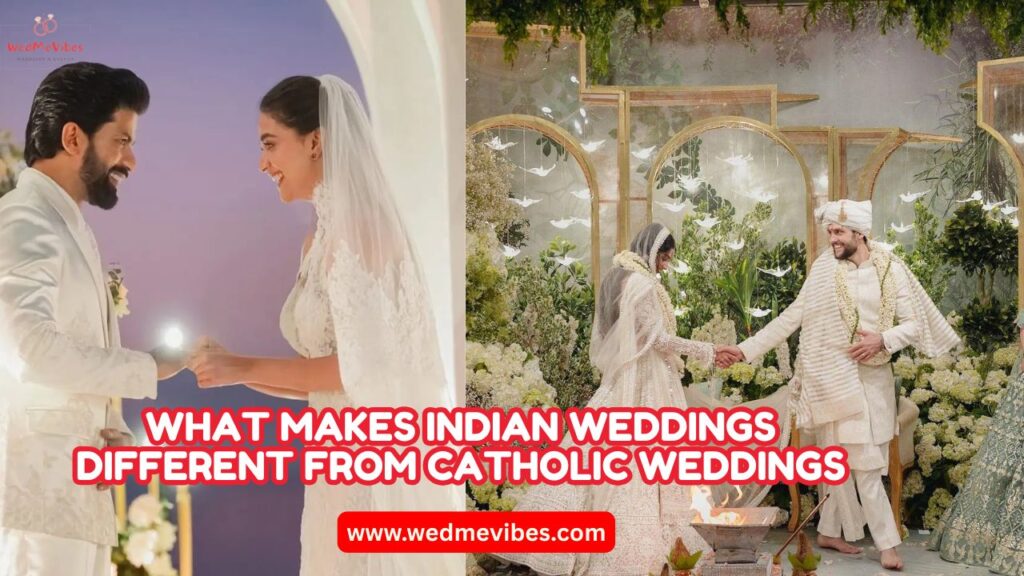
Weddings are special everywhere, but Indian weddings and Catholic weddings are very different from each other. They have different customs, clothes, food, length, and meaning. Let’s look at the main differences in a simple way.
1. How Long the Wedding Lasts
- Catholic wedding: Usually one day only. The main part is the church ceremony (30 minutes to 1 hour) and then a reception party with dinner and dance. Everything finishes the same day.
- Indian wedding: Most Indian weddings last 3–7 days! There are many small functions before the main wedding day—like mehndi (henna party), sangeet (music and dance night), haldi (turmeric ceremony), and then the actual wedding day with many rituals. Even after the wedding, there are more parties. So it feels like a week-long festival.
2. Where It Happens
- Catholic wedding: Almost always inside a church. The priest marries the couple in front of God and guests.
- Indian wedding: Can happen anywhere—big banquet hall, hotel, farm house, or even at home. Hindu weddings often have a mandap (decorated canopy with four pillars) where the main rituals happen. The place is full of flowers, lights, and bright colors.
3. Clothes
- Catholic wedding: Bride wears a white gown, groom wears a black or dark suit or tuxedo. Bridesmaids and groomsmen also wear matching colors.
- Indian wedding: Bride wears bright colors—mostly red, pink, gold, or green lehenga or saree with heavy jewelry and makeup. Groom wears sherwani or suit in gold, cream, or bright colors, and often a turban or saafa. Everyone wears colorful traditional clothes, lots of gold jewelry, and bindis.
4. The Ceremony Itself
- Catholic wedding: Short and serious. The couple says vows, exchange rings, priest declares them husband and wife, and they kiss. There is Holy Mass, readings from the Bible, and blessings.
- Indian wedding: Very long (2–5 hours) and full of rituals. In Hindu weddings, the couple walks around the holy fire seven times (saat phere), the groom puts sindoor (red powder) in the bride’s hair, they exchange flower garlands (jaimala), and the bride’s parents do kanyadaan (giving away the daughter). There are mantras, fire, rice throwing, and many small traditions.
5. Family Involvement
- Catholic wedding: Family is important, but the day is mostly about the couple.
- Indian wedding: The whole family (and sometimes the whole community) is part of every ritual. Parents, uncles, aunts, cousins—all have some role or the other. It feels like two big families are joining, not just two people.
6. Food and Party
- Catholic wedding: Usually one big reception dinner. Food can be sit-down meal or buffet, often Western or local dishes, cake cutting, and dancing.
- Indian wedding: Food is served many times over many days. Mostly vegetarian for Hindu weddings, with lots of sweets, chaat, paneer dishes, naan, biryani, and different curries. There is loud music, DJ, dance performances by family members, and fireworks.
7. Arranged or Love Marriage
- Catholic wedding: Almost always love marriage. The couple chooses each other.
- Indian wedding: Both love and arranged marriages happen. Even today many Indian weddings are arranged or semi-arranged by parents, though the couple usually gets to say yes or no.
8. Symbols and Meaning
- Catholic wedding: Focus on becoming one in the eyes of God, lifelong promise, and starting a Christian family.
- Indian wedding: Focus on family union, blessings from elders and gods, continuation of culture and traditions. Astrology, auspicious dates, and rituals for good luck are very important.
9. Guest List
- Catholic wedding: 50–200 guests is normal.
- Indian wedding: 300–1000+ guests is common! Sometimes even more. Everyone is invited—relatives, neighbors, family friends, colleagues.
Conclusion
Both Indian and Catholic weddings are about love, commitment, and starting a new life together, but they show it in completely different ways. One is quiet, short, and focused on God and the couple. The other is loud, colorful, long, and all about family, tradition, and celebration. No matter which one you attend, both leave you with happy memories—one fills your heart with peace, the other fills the air with music, laughter, and lots of food. At the end of the day, every culture has its own beautiful way of saying “happily ever after.”